



2026 Euros tidbits
February 5, 2026
By Reut Golinsky
Photo © Reut Golinsky, Eva Maria Jangbro (EMJO)
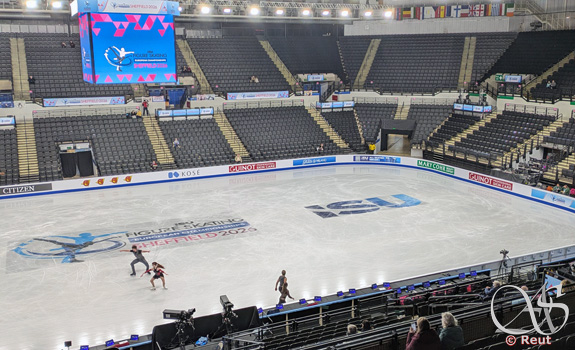
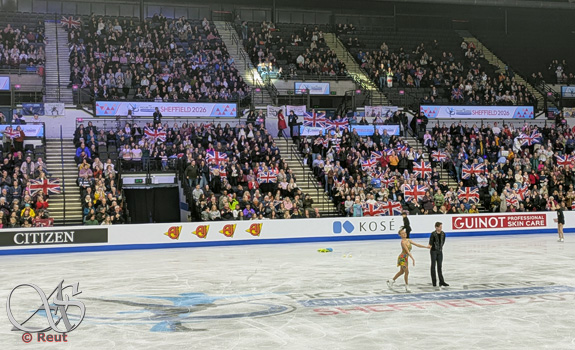
The 117th ISU Figure Skating European Championships in Sheffield (GBR) delivered spectacular performances and plenty of unforgettable moments, creating a warm and vibrant atmosphere throughout the week of January 13 to 18. Before the world's eyes shift to the grandest stage, Milano Cortina 2026, we pause to look back at some of the stories that made our visit to the Steel City so special. Among these, we also want to give more attention to those deserving skaters who won't be in the Olympic spotlight but definitely left their mark.
Redefining the in-arena experience
The "Leader's Chair" is a new, prominent seating area introduced by the ISU during Worlds 2025 in Boston. It was designed to reimagine the backstage "Green Room" by placing the leading skaters from the final groups of free skating and free dance right beside the Kiss & Cry area. This setup allows spectators and cameras to capture the immediate, emotional reactions of the current leaders as they watch their competitors perform in real-time, resulting in more interactions between the skaters and much more.
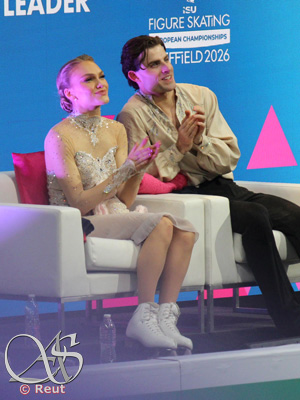 This is part of the ongoing effort to enhance the experience of watching the competition live, as fans watching from home get only limited footage showing side-by-side frames of Kiss & Cry and current leaders - something they also had with the "Green Room," even to a greater extent, since the top three leaders were present there. For journalists waiting in the mixed zone, this innovation adds headaches and creates even more uncertainty about who and when they will be able to interview during the second half of the competition. But it seems the skaters truly enjoy this experience.
"At first in Boston I thought it was going to be awful," Olivia Smart shared in the new episode of her vlog. "But it was so fun! Well, it is fun if you skated great. You're the leader, and you're sitting in this chair, with pride. Usually you don't get to sit down after a free dance and chill. So I was just really enjoying it. I sat next to Tim, enjoying this moment and taking it all in. Also, kind of debriefing what just happened because usually we go straight into the mixed zone after we compete and just talk to people, do interviews. So to have this was really special, to do that knowing I could look at the crowd and see who was there and also watch the other teams. We don't get to sit and watch the teams we don't train with often. And here I got to watch their programs and enjoy them from a front-row seat! So that was a very cool moment, because they are not just skaters, these are my friends as well. So sitting there and supporting them was really, really cool."
Messages on the jumbotron were another feature introduced during Worlds 2025 to add more fun moments for the crowd in the stands (they aren't shown to spectators during the stream, which is a real pity!). 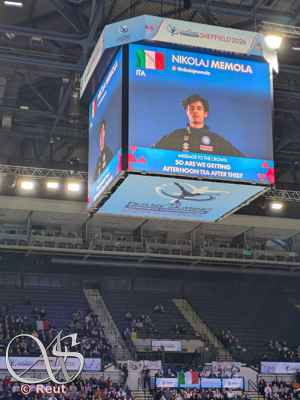 Some messages are bland, some are fun, and some are more specific - about the program, the music, or the location of the event. Some skaters put a lot of thought into them, while others ask ChatGPT for ideas (they confided in us, but we won't share any names).
Some, like Niina Petrokina, use them as inspiration for themselves and their fans: "I wrote 'Feel the crowd, feel the moment' because I wanted to share that energy. And I felt all that today." Others, like Michel Tsiba and Daria Danilova, encourage the crowd to be loud "because we knew it's the end of the week, we're the last group, and we just needed that extra push from the crowd." While we wish that Minerva Hase and Nikita Volodin found hope even when they didn't finish first.
An added bonus: these messages work as great ice breakers for interviews or short talks in the mixed zone. For example, we discussed with Ean Weiler why his motto ("I fight until I get it right") is not always the best approach. Or Anna Pezzetta, during the press conference, explained how, while being a "hot mess," she still earned a small medal for her short program (because the second half of her message was about being "100% locked in," which she was). And, of course, you can't help but count all the "Marias" mentioned in Júlía Gunnarsdóttir and Manuel Piazza's free skating after they asked about it in their message.
Ean Weiler: "I fight until I get it right"
He has conquered the triple Axel and is now working on a quad. After moving to the Skating School of Switzerland at the beginning of last season, he admitted during his Kiss & Cry interview that being coached by Stéphane Lambiel is "fun, but not easy." We caught up with Ean Weiler after his successful short program to talk about his European debut and more.
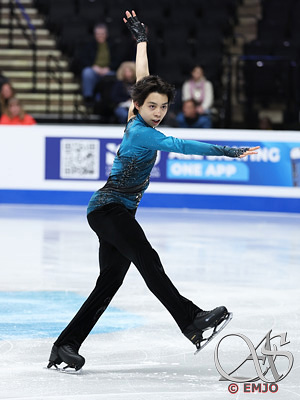 "I was really nervous, but it was better than I thought. As soon as I landed my last jump, I was just happy that I got through it. It was really overwhelming. I didn't know if I was more happy or stressed, but now that I'm here, I feel welcomed," he summed up his experience.
Ean has a busy season, switching between junior and senior-level competitions - something he admits is not easy. Still, it allowed him to finish second at senior Nationals and earn a spot in Sheffield. For now, his strategy is to stay present and take one competition at a time: "To be honest, I was just focusing on every single competition. I didn't think about the future. I didn't think about the past. But I'm here now, and I will do my best."
The sentence Ean chose to display on the jumbotron before his performance read: "I fight until I get it right."
"I'm a perfectionist. So if some little detail is not perfect, I'll do it again and again until it's how I want it," he explained. A great mindset for an athlete - but maybe not always? "It's not good when I have things that are out of my control or when I've gone too far. Then I feel I need to stop, I need to rest," he agreed.
His costumes are created by Satomi Ito, the Japanese fashion and costume designer known for her work in figure skating as well as artistic and rhythmic gymnastics. "My idea was mainly about the colors - black and petrol - and then she got creative and proposed this one sleeve. At first, I was a bit unsure about how it looked, but now more and more I feel that it suits me."
Tamir Kuperman: "There is so much more to improve in my skating"
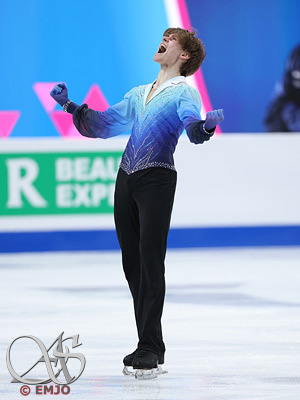 National champion and three-time junior national champion, Tamir Kuperman is competing in his first full senior season. He was unable to qualify for the Games at Skate to Milano, finishing only 10th, and so, approaching his European debut, he initially set a modest goal: to qualify for the free skating. But after achieving a Personal Best score of 79.82 points, he decided he had to aim higher.
"I felt super nervous, but once I took the ice I just focused on my skating. I felt really happy at the end of my skate. To tell the truth, I didn't expect to get such a high score, because my Salchow was with a 'q' and I touched the ice. I feel that at my previous competition in Warsaw I had a cleaner skate and got 72, so I expected around 70 points, which should have been enough to qualify. But then I saw 79! It was a great feeling. We didn't discuss placements with my coaching team, but deep down, of course, I would love to be in the top ten," he said after the short program.
And he did this two days later, finishing 7th overall with yet another Personal Best score of 150.35 points and securing two spots for Israel for next year.
He was very pleased in the mixed zone about both his achievement and the overall experience in Sheffield: "It was amazing! And sharing the ice with such top skaters, skating in the same group as Deniss Vasiljevs - a skater who has been at the top for so many years - was such an honour."
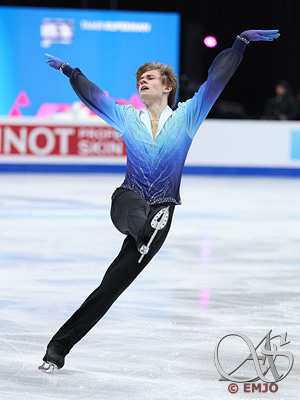 Tamir skates to "The Four Seasons" in his short program and "The White Crow" in his free skating; both were chosen by him from options his coach, Galit Chait, proposed. "Sometimes I feel more pressure," he admits about his iconic music choices, "when, for example, I recall that Shoma Uno also skated to this music. If I watch his skating and then compare it to mine, I feel like there is still a very long way to go. Well, that's a usual feeling actually, I always feel that there is so much more to improve in my skating." Especially when it comes to conveying a story and character, he adds, the technical content is very demanding and sometimes he is too focused on executing it well.
His technical content is indeed impressive: two quads in the short program (4S, 4T-3T) and three in the free skating (4T, 4T-2T, 4S). "Before Euros we decided to take the quad Lutz out and leave only two toe loops and the Salchow, because it still wasn't ready and in some competitions I failed with both the Salchow and the Lutz. So we decided to go with only one of them. The plan is to add the Lutz back, and towards next season maybe even add the quad Loop."
Anna Valesi and Martin Bidar: "Our connection has become even stronger"
Anna Valesi and Martin Bidar are a new team we first met in Bergamo at the beginning of the season. Since then, they have tried their luck at the qualifying competition in China, Skate to Milano, where they finished seventh, won silver at the Tayside Trophy, and claimed their first national title together.
"We're still a relatively new pairs team, but during the first half of the season we experienced a lot of different situations, and so I can say that since we talked at the Lombardia Trophy our connection has become even stronger. And I can truly say that I'm proud of us - not just for the work ethic, 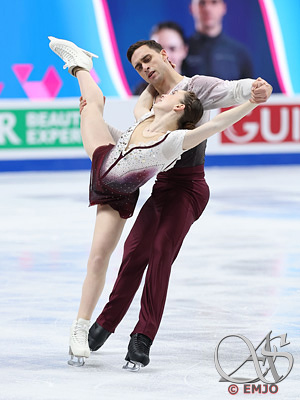 but also for how we approach every training, how we try to show and explain to younger pairs about support, about having fun and about being kind. Kind towards ourselves and to each other," Anna said.
"And I think it's really good that even when we have a really difficult practice, we always find a way to get the best from that day. I think that's our power," Martin continued.
"And even during the hardest day Martin finds a way to make me happy and make me laugh," Anna added.
They did very well for a new team and earned a Personal Best score in their free skating of 113.62 points. "The connection, everything felt good today," Anna said. "From the very morning I felt really, really good. So I was almost scared that I'm feeling too good, you know? But in the end everything went well together and it was really amazing," Martin added.
Right during our talk they learned that they would finish in the top ten overall and could bring another Czech pairs team with them next year, so the excitement spiked. "We hope so! We have a junior pair that can become seniors next season. Fingers crossed! That would be nice, to have another Czech team coming."
Their biggest goal and highlight of the season will, of course, be the home Worlds in Prague. "We are really looking forward to it! Europeans was our first bigger competition, so we experienced all the pressure here, but in Prague it will be even more, so we think it was a good test."
Shira Ichilov and Mikhail Nosovitskiy:
"It feels like we've skated together for years"
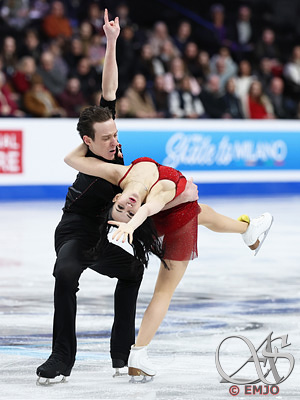 Shira Ichilov and Mikhail Nosovitskiy teamed up last spring. Both already had vast experience with previous partners, but it feels like this particular partnership will be going places. As both were coached by Galit Chait before, the adjustment went pretty smoothly. "We took each other's hand and started skating immediately. We're very aligned, we think the same, we decide everything together, work as a team," they explained.
"To tell the truth, sometimes I even forget that we've only been skating together for just over eight months. It feels like we've skated together for years, and then I check the calendar - wow, it's not even been a year," Mikhail added.
Shira Ichilov and Mikhail Nosovitskiy teamed up last spring. Both already had vast experience with previous partners, but it feels like this particular partnership will be going places. As both were coached by Galit Chait before, the adjustment went pretty smoothly. "We took each other's hand and started skating immediately. We're very aligned, we think the same, we decide everything together, work as a team," they explained.
"To tell the truth, sometimes I even forget that we've only been skating together for just over eight months. It feels like we've skated together for years, and then I check the calendar - wow, it's not even been a year," Mikhail added.
They obviously needed to choreograph a new rhythm dance, but because of the shortage of time they decided to reinvent the "Muse" free dance Mikhail had already skated with his sister. "We changed a lot - you could say that only the music stayed the same - and we feel we made this program our own, as if it had been created for this partnership from the start. We really love this program, but we've already started thinking about what to do next. This season was about presenting ourselves, trying things out, but next season we will need to fight for higher placements."
Among other "Muse" programs, which are quite popular in figure skating, they both praised Charlène Guignard and Marco Fabbri's free dance from the 2017/18 season.
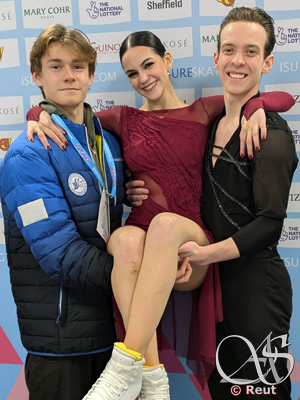 They tested the waters at Skate to Milano, and even though it was pretty clear they wouldn't be able to qualify, it gave them a taste for more. Maybe it was even for the better, Shira suggested: she definitely aims for the Games, but wants to arrive ready, not just to participate, but to show their best as a team.
"It was so great! The audience was great!" Mikhail summarised their first Europeans together. "We watched Tamir's skate earlier today and it motivated us even more. We feel that we accomplished everything we planned for this competition; overall it was a decent result for our first Euros."
"I felt really great," Shira agreed. "It was a great debut at the Europeans, we just showed our heart on the ice today! I enjoyed it so much, and I am glad we had two clean skates. Tamir's skating inspired us. Our team is really growing now, and I am glad we can experience it all together-we have such an amazing team!"
It was lovely to witness how sincerely they cared about each other and made sure to come and cheer for one another - many more competitions together to come.
Júlía Sylvía Gunnarsdóttir and Manuel Piazza:
"You may say we're dreamers"
This event was special for Iceland's first-ever pair not only because this time they qualified for the free skating - "even though technically everyone qualifies now, it still feels amazing" - but also because, thanks to the Olympic year and earlier dates, it fell on Júlía's birthday.
"This was my first time competing on my birthday since it's so early in the year, and I didn't know what to expect. 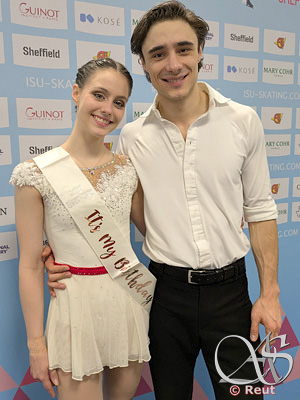 It was amazing, so surreal, and I'm so grateful," Júlía said in the mixed zone after journalists greeted her with a "Happy Birthday" song.
As they finished just outside the top ten, the legitimate question was: does Iceland even have another pairs team? "Sadly, not even close," Manuel answered. "We just have one little boy, and that's it. Even if he decides to do pair skating, it's going to take a couple of years. But hopefully, seeing us skate will make some other boys realize they can come join in."
Regarding the important question they asked on the jumbotron ("Can you guess how many times the song says Maria?"), Júlía explained: "It's a trick question. It's 28 times in the song itself, but our team leader's name is Maria, so we usually say technically it's 29. The 10th 'Maria' is on the twist, about half of the program has all of the 'Marias,' and then there's one at the end. It was Manuel's idea to make this the message to the crowd because we always joke about it in practice. Sometimes, when I see other skaters for the first time during the day, they look at me and go, 'Maria?'"
Before the short program, they had a different message, of course. Also connected to their program's music, "Imagine" by John Lennon. "That specific verse isn't in the program, but it's one of our favorite quotes. We made it plural because we talked about ourselves - 'you may say we're dreamers, but we're not the only ones.'"
Well, they definitely are dreamers, but dreamers who make their dreams come true. Among their next goals: achieving a minimal technical score to qualify for Worlds in Prague.
Josefin Taljegård: "We all keep going and keep fighting"
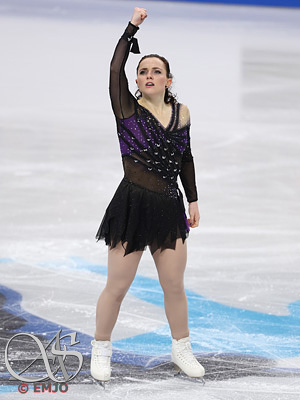 It is always a pleasure to see Josefin Taljegård perform. Considering these might be her last Europeans, it felt even more special.
"This is one of the Europeans that I've enjoyed the most so far," she said after her short program. "When I was going off the ice, I knew I made some technical mistakes, yet I have no idea why the points were so low, it wasn't as disappointing as a 50-point program should be. But I am going to skate my free skate, so I have a chance to do better, and I feel like I have so much more to give.
My mindset here was different from other Europeans, where I was more focused on which jumps I needed to get the most points, or maybe debating this or that. This time I knew what I was going to do and just thought, let's do it! Before my skate there was really good music playing and we were just vibing. I like that part of figure skating, and I think we need more of it because some other sports have more entertainment value, but we're improving. I definitely didn't mind having an interview in Kiss & Cry. Mark is such a professional and it was so much fun, for the audience as well."
Josefin's short quite symbolically tells her own story, "a story about someone who has been fighting in this sport for a very long time, and no matter what they throw at me, I keep going and I feel like a survivor. But it's a universal thing; we all keep going and keep fighting." Like with any good storytelling, others might interpret it differently and relate to it because they, too, have survived challenges in their lives.
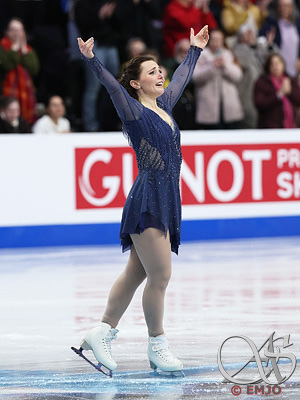 This program and its theme helped her push through the season, she agreed, and even more than that: "It was the thing that helped me decide whether I should continue competing this season, because after Worlds last year, that wasn't even my plan. So it definitely helped me and made me continue up until now."
And we're so happy she did, because her free skating in Sheffield was one of the highlights of that day - and maybe of the whole competition. It's very rare to see a standing ovation in one of the earlier groups, but that only shows how special her performance was and how knowledgeable the audience was to appreciate it. "When the music stopped, I was really overwhelmed. I saw more and more people rising, standing, and clapping, and it meant so much to me!" she shared. "I landed all my jumps, and I don't care about the scores, because I had an amazing skate!"
"Nothing is mathematical!"
How do you measure love? How do you score the standing ovation, the electrifying atmosphere a performance creates? How do goosebumps translate into points? Can you do that? Should you?
Stéphane Lambiel exclaimed in our interview a few years ago: "It's become too mathematical, which is terrible, and we need to move away from it. I'm emotional about it because all these small details and numbers are killing my sport." He repeated similar words in the Kiss & Cry after Deniss' short program score appeared: "You're killing figure skating."
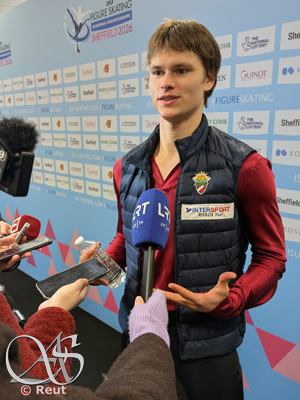 Yes, we need objective judging. Yes, we need this to be a sport that can be measured and compared for it to remain an Olympic discipline. Yes, the main idea was to move from the abstract 6.0 system to a detailed "price list" that shows exactly where points were gained and which elements need more work. But not once, and not just twice during this event, did the impression we had from the performances - and even the feelings the skaters themselves experienced - align with the scores they received. In fact, the gap between them was often striking. This doesn't necessarily mean the judging was unfair, but it shows that something is seriously wrong with the current approach, especially if we claim our main goal is to make the sport popular.
Josefin Taljegård received a standing ovation for her beautiful free skating, a moment that nearly brought her to tears. Mark Hanretty named it one of his highlights of the day - and many would agree. Yet Josefin often struggles to earn scores high enough to qualify for the World Championships, something some argue cost her a chance at the upcoming Games as well. Her gem of a program could adorn any major competition; the world deserves to see performances like hers.
Deniss Vasiljevs shared his thoughts with fans: "I was extremely sad after the short program even though I had a good moment and felt good. The preparation was short, I had my own struggles, and coming with all of that, I skated my heart out which made me feel super good. It was not perfect, but it was enough to be proud of. Then you have this long wait and you think: 'Yeah, if it takes them longer to evaluate than the whole program itself, there must be a lot of questions.' So you keep smiling there: 'We're doing good. nope, we're not, but keep smiling.'  And then you get the score: 'Yep, that didn't go well.' You have this moment of extreme height and then this drop down. Emotionally, that was quite a big shock."
Olivia Smart mentioned something similar in her vlog: "We had a tiny stumble, a mistake in our step sequence. But it was so tiny we didn't think we'd be penalized for that. And then the score came up... They didn't let us get away with that. It's so strict and so cruel, but that's what ice dance technical rules are. I was really happy after our rhythm dance - that's the sad part. That whole day, that event was so much fun and so memorable, but then because of the score and the placement, we were both so bummed. It overshadowed the joy we had from the rhythm dance."
Sheffield 2026 is in the books. Like every big competition, it was filled with emotions: ups and downs, big and small victories, tears and laughter. This year, the overall level felt lower, which is understandable: perhaps skaters were so focused on qualifying for the Games that they gave their all earlier and are still not at their peak, saving it for the Olympics; many were injured earlier and Europeans was their first major competition of the season.
Yet there were still passionate performances, standing ovations, raw feelings, and all those things we love figure skating for. Is the state of figure skating ideal? Definitely not. Is figure skating dead, did we kill it? Probably not. Like always, the truth lies somewhere in between. But with multiple voices speaking out and a new Olympic cycle starting soon, it feels like the right time for a change.